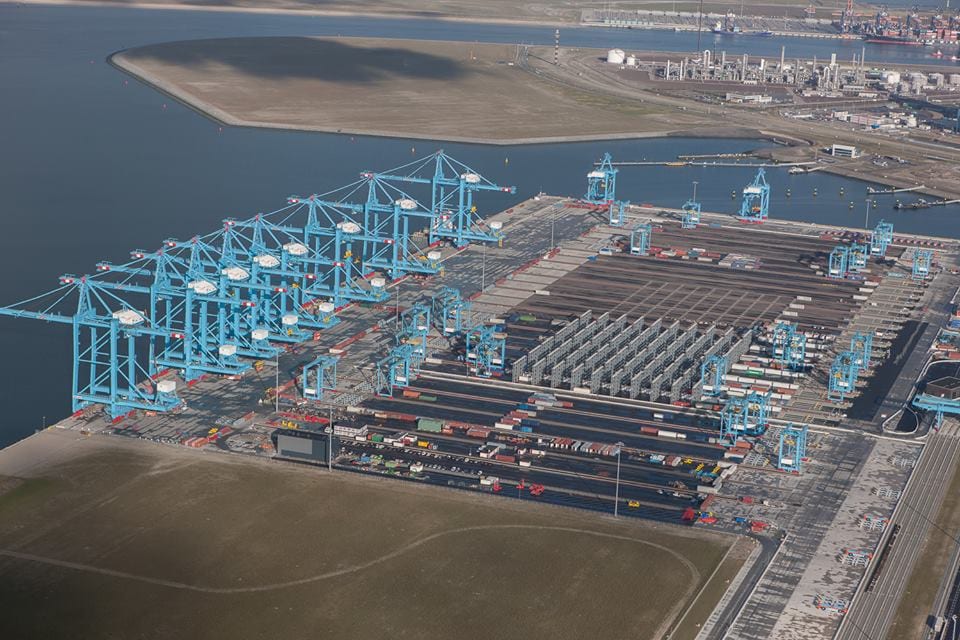
APM Terminals Maasvlakte II Rotterdam facility. Photo: Maersk/Facebook
APM Terminals has opened its new Maasvlakte II container terminal at the Port of Rotterdam, said to be the most technologically advanced and environmentally sustainable facility of its type anywhere in the world.
The APM Terminals Maasvlakte II Rotterdam facility is constructed on land entirely reclaimed from the North Sea and designed as a zero-emissions multi-modal hub to reduce truck traffic in favor of barge and rail connections to inland locations.
The facility is the first to use remotely-controlled STS gantry cranes, moving containers between vessels and the landside fleet of 62 battery-powered Lift-Automated Guided Vehicles (Lift-AGVs), which transport containers between the quay and the container yard, including barge and on-dock rail facilities. The Lift-AGV’s also represent the world’s first series of AGV’s that can actually lift and stack a container. A fleet of 54 Automated Rail-Mounted Gantry Cranes (ARMGs) then positions containers in the yard in a high-density stacking system.
The terminal utilizes wind-generated electricity to power its operations, producing zero CO2, emissions or pollutants, and is also considerably quieter than conventional diesel-powered facilities.
The terminal was officially opened on Friday during a ceremony attended by The Netherlands’ Monarch King Willem-Alexander, and 500 senior representatives from the global shipping industry and world governments.
APM Terminals CEO Kim Fejfer said: “We are honored to officially dedicate our new terminal with you today. APM Terminals Maasvlakte II is clearly a game-changer port in the shipping industry designed to exceed our customers’ expectations. It is significantly safer for our people and all users of the port. It runs on a zero emissions, sustainable business model using renewable energy, benefitting the people of Rotterdam and Europe. And, equally important, our shipping line customers will experience 40% higher productivity – thanks to automation.”
Construction of Maasvlakte II began in May 2012, with the first commercial vessel call in December 2014. Successful systems testing and ramp-up have been completed to bring the first phase of APM Terminals Maasvlakte II into full operational status.
The 86 hectare (212 acre) deep-water terminal features 1,000 meters of quay, on-dock rail, and eight fully-automated electric-powered Ship-to-Shore (STS) cranes, with an annual throughput capacity of 2.7 million TEUs, representing an APM Terminals investment of EUR 500 million. At planned full build-out, the terminal will cover 180 hectares (445 acres) and offer 2,800 meters of deep-sea quay (19.65 meters/64.5 feet depth), with an annual throughput capacity of 4.5 million TEUs.
“The future of terminal operations is safer, high-volume, high-productivity performance” added Mr. Fejfer, adding “We are pleased to welcome that future here today.”
The existing APM Terminals Maasvlakte I Rotterdam container terminal, which will remain in service, handled 2.46 million TEUs in 2014.

Opening Ceremony of APM Terminals Maasvlakte II Kicks Off
 CEO APM Terminals Kim Fejfer speaking at MVII opening celebrations
The opening ceremony of APM Terminals Maasvlakte II port located in Rotterdam, the Netherlands has officially opened today afternoon.
APM Terminals’ newest port in the world will be the first fully automated facility with zero emissions from cargo handling equipment.
Built on land reclaimed from the North Sea – the port is described by APM Terminals as an engineering marvel that will set the pace for other ports worldwide in sustainability, higher productivity, safety and innovation.
The total cost of the investment is said to be EUR 500 million.
The Dutch King Willem-Alexander, and 500 senior representatives from the global industry and world governments are attending the opening event, which has included speeches by Maersk Group CEO Nils S. Andersen and APM Terminals CEO Kim Fejfer.
“The development of MVII is about team work, cooperation, leadership, passion,” said Fejfer while speaking at the ceremony.
“We demonstrate that safety, efficiency, sustainability and world economic trade can go hand-in-hand,” he said, adding that “MVII project began with listening to our customers and stakeholders.”
“APM Terminals You have added another world class facility to our port,” said Mr Allard Castelein, CEO of the Port of Rotterdam.
Sustainability also ranks high on the list of ambitions of the new port with the recent signing of a two-year contract for environmentally-sustainable wind-generated electricity. This electricity will be used to drive virtually all terminal equipment including the battery-driven lift Automated Guided Vehicles (AGVs) for container transport within the yard.
The 18,300 TEU EEE-Class Marstal Maersk became the largest vessel to call the new Maasvlakte II expansion of the Port of Rotterdam, arriving on January 5th as part of the testing phase prior to regular weekly calls starting in February.
The new world’s safest and fully automated APM Terminals facility Maasvlakte II has opened in Rotterdam. Willem-Alexander, the Monarch King of Netherlands and 500 senior representatives from the shipping industry and government institutions from all around the world attended the celebration for the opening of the world’s most technologically modern and environmentally friendly container terminal.

The Rotterdam Maasvlakte II facility launches the first container terminal in the world using remotely-controlledSTS gantry cranes which transfer containers between vessels and the 62 battery-powered Lift-Automated Guided Vehicles (Lift-AGVs). Having been the first AGV series in the world, the Lift-AGVs transport containers between the quayside and the container yard. After the transfer from seaside to the quay, 54 Automated Rail-Mounted Gantry Cranes (ARMGs) arrange the containers in a high-density stacking system in the yard. The whole transportation process is supported by a barge and on-dock rail facilities.
The APM Terminals Maasvlakte II facility in Rotterdam is environmentally sustainable. The power requirements of the terminal for its operations, are provided by electricity that is wind-generated. The technology is environmentally friendly, with no CO2 emissions or pollutants, and much more quieter in compare with the conventional diesel-powered facilities.
Construction works of the facility started in May 2012 with the first merchant ship call in December 2014. As a multi-modal hub, the terminal was constructed on land completely reclaimed from the North Sea and with the main purpose to make less the truck traffic, helping the barge and rail network to island locations. The first stage in the Maasvlakte II operational status was completed by successful systems testing and ramp-up. In the EUR 500- million APM Terminals investment are included 86 hectare deep-water terminal, characterized by 1,000 meters quay, 8 fully-automated electric-powered STS cranes with а capacity to transfer 2,7 million TEUs per year and on dock rail, as well.
When the project is finished the terminal will offer 2,800 meters of deep-sea quay with 19,65 meters (64,5 feet) depth and will cover-up 180 hectares. The terminal is expected to have 4,5 million TEUs throughput capacity per year.
The Chief Executive Officer of APM Terminals Kim Fejfer said:
“The future of terminal operations is safer, high-volume, high-productivity performance.”
The currently operating APM Terminals Maasvlakte I in Rotterdam will continue its service operations. For the first six months of 2014, the APM facility was cited as the most productive container terminal in Europe by an independent Journal of Commerce industry study, with its 102 crane moves per hour and about 2,46 million TEUs that were transferred through the terminal for the previous year.
Source&Photo: APM Terminals